This is a subtitle for your new post
Why Is My ABS Light On? A Complete Guide for Starkville, Columbus, and West Point Drivers
Your vehicle has one job when something isn’t working the way it should: communicate with you through the dashboard. Every warning light is designed to give you early information—long before a breakdown or dangerous situation occurs. Out of all the indicators your vehicle can display, the ABS light is one of the most important.
When the ABS light comes on, even though your brakes might still feel normal, your vehicle is telling you that a major safety system—the Anti-Lock Braking System—isn’t functioning correctly. That means your traction, steering control, and stopping stability are already compromised.
This matters even more for drivers in and around Starkville, Columbus, and West Point, where daily driving includes unexpected stops, busy traffic corridors like Highway 12 and Highway 45, unpredictable Southern rain, and mixed road conditions across Oktibbeha, Lowndes, and Clay Counties.
This comprehensive guide covers:
• What ABS is
• Why the ABS light turns on
• The most common causes
• How your braking performance changes
• What happens if you ignore it
• Why Mississippi driving patterns increase ABS wear
• What proper diagnostics look like
• And how to get accurate repairs from a trusted local shop
Let’s break everything down clearly.
What the ABS Light Really Means
ABS—the Anti-Lock Braking System—prevents your wheels from locking during hard or sudden braking. Wheel lock-up causes:
• Loss of steering
• Loss of traction
• Sliding or skidding
• Increased stopping distance
• Reduced control on wet or uneven roads
ABS works by rapidly pulsing brake pressure at each wheel, allowing the tires to grip the road instead of sliding across it.
When the ABS light turns on, the system has disabled itself due to a detected fault. Your standard brakes still function, but:
• The extra safety layer is gone
• Traction may be reduced
• Steering control during emergency braking is limited
This is especially important on Mississippi’s wet, humid, and sometimes uneven road surfaces—conditions that ABS is designed to help you navigate safely.
The 10 Most Common Causes of ABS Warning Lights
ABS systems combine electronics, hydraulics, sensors, tone rings, and modules. When one component fails, the warning light activates.
Below are the most common causes.
1. Wheel Speed Sensor Failure
Each wheel has a sensor that reads rotation speed. ABS must know which wheels are spinning and which are locking.
Wheel speed sensors fail due to:
• Dirt, mud, and road film
• Corrosion
• Wiring damage
• Age and wear
• Pothole or debris impact
Mississippi roads—especially rural stretches, county roads, and routes around Starkville, Columbus, and West Point—collect dirt and moisture that accelerate sensor contamination.
2. Damaged Tone Ring
The tone ring works with the speed sensor to track how fast the wheel is rotating. When it is:
• Cracked
• Rusted
• Loose
• Clogged
…the system loses accurate wheel-speed data and disables ABS.
Tone rings corrode faster in humid, rainy climates like Northern Mississippi.
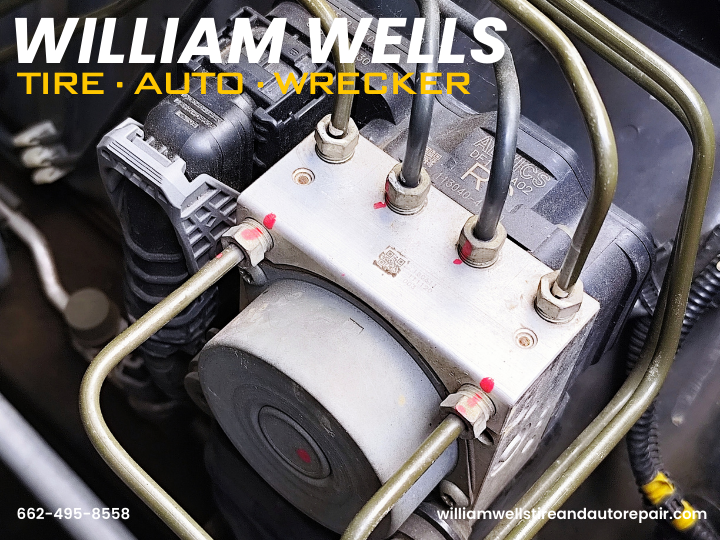
3. ABS Control Module Failure
The ABS module is the electronic brain of the system. When it malfunctions:
• The ABS light stays on
• Traction control may shut off
• The system cannot regulate brake pressure
ABS modules fail due to:
• Internal electrical faults
• Corrosion
• Pump motor burnout
• Moisture intrusion
• Age
Older vehicles commonly experience module wear.
4. Low Brake Fluid
ABS depends on strong hydraulic pressure. Low fluid causes the system to malfunction.
Low brake fluid usually indicates:
• Brake pad wear
• Small leaks
• Fluid breakdown
• Moisture contamination
Mississippi’s heat and humidity degrade brake fluid faster than average.
5. Blown ABS Fuse
A blown fuse interrupts power to the ABS system. Even a small electrical issue can lead to a full system shutdown.
Causes include:
• Voltage fluctuations
• Moisture
• Short circuits
• Aging electrical components
A fuse fix is simple—but the cause behind it must be diagnosed correctly.
6. ABS Pump or Hydraulic Control Unit Failure
The pump maintains the pressure needed for ABS to function. When it fails:
• ABS activates incorrectly
• Pedal feel changes
• The warning light appears
Pump failures occur more often in older vehicles or those exposed to moisture.
7. Worn Brake Pads or Rotors
Worn brake components don’t directly trigger the ABS light, but severe wear disrupts hydraulic balance.
This reduces ABS effectiveness and triggers warning signals.
8. Weak Battery or Charging System
ABS modules are voltage-sensitive. A weak battery or alternator causes:
• ABS shutdown
• Traction control shutdown
• System malfunction codes
Cold mornings, short trips, and aging batteries all contribute.
9. Incorrect Tire Size
ABS expects all tires to rotate at the same calibrated speed.
If tires are mismatched due to:
• Partial replacement
• Aftermarket rims
• Uneven wear
…the system registers incorrect data and triggers the warning.
10. Traction Control or ESC Problems
ABS shares components with traction control and electronic stability control.
When one system fails, warning lights for all three may illuminate.
What Happens If You Ignore the ABS Light?
Your brakes still function, but your ability to maintain control during emergency braking changes drastically.
Here’s what ignoring the ABS warning leads to.
1. Increased Risk of Skidding
Mississippi’s rainstorms create slick roads, especially during the first few minutes of a downpour. Without ABS, wheels can lock easily, increasing the chance of skidding.
2. Loss of Steering Control Under Hard Braking
With ABS disabled, steering becomes limited when wheels lock. This is extremely dangerous on busy routes like:
• Highway 12
• Highway 45
• MS-182
• Main Street through West Point
• Macon Road in Columbus
3. Longer Stopping Distances
ABS stabilizes brake pressure. Without it, stopping distances increase significantly—especially on:
• Wet pavement
• Gravel roads
• Rural county routes
4. Loss of Traction Control
ABS and traction control share critical components.
When ABS fails:
• Traction control usually disables
• Stability control may disable
• Slipping, spinning, and sliding increase
This is especially noticeable on curved or uneven rural roads.
Why ABS Issues Are Common in the Starkville–Columbus–West Point Area
This region’s climate, terrain, and driving patterns create consistent ABS stress.
1. High Humidity and Rainfall
Moisture is the #1 enemy of ABS systems. It causes:
• Sensor corrosion
• Tone ring rust
• Electrical oxidation
• Module damage
Northern Mississippi’s humidity accelerates all these failure points.
2. Rural Roads with Gravel and Mud
Many roads in Oktibbeha, Lowndes, and Clay Counties feature:
• Gravel portions
• Dirt shoulders
• Mud patches
• Washed-out sections
These conditions contaminate sensors and damage wiring.
3. Temperature Extremes
Mississippi summers are hot. Winters bring cold mornings. These temperature swings:
• Weaken electrical components
• Accelerate fluid breakdown
• Stress tone rings and seals
4. Heavy Stop-and-Go Traffic
Busy streets in Starkville, Columbus, and West Point require frequent braking, increasing:
• Pad wear
• Rotor wear
• Fluid usage
• Sensor contamination
5. Older Vehicle Population
Many households across the Golden Triangle region rely on older vehicles—making ABS failures more common.
Signs Your ABS Light Needs Immediate Attention
Professional diagnostics are needed if:
• The ABS light stays on
• It flashes intermittently
• Traction control light also appears
• The brake pedal feels abnormal
• ABS activates at low speeds
• Steering pulls during braking
• Grinding or clicking noises occur
• Stopping distance increases
These are signs the system is actively failing.
What Proper ABS Diagnostics Should Include
ABS cannot be diagnosed with a basic scanner. Proper diagnostics must include:
• Manufacturer-level ABS scan
• Wheel speed sensor graphing
• Tone ring inspection
• Hydraulic pressure testing
• Brake fluid testing
• Electrical continuity checks
• Pump motor evaluation
• Module communication testing
• Road testing with live data
This ensures the root cause—not just the symptom—is found and fixed.
Golden Triangle Roads That Stress ABS Systems
Local roads that frequently cause ABS-related issues include:
• MS-182 in Starkville
• Highway 12
• Highway 25
• Highway 82
• Macon Road in Columbus
• Main Street in West Point
• Artesia Road
• 45 Alternate
• County roads with gravel or uneven pavement
These roads expose your ABS components to moisture, debris, vibration, and sudden braking cycles.
When to Contact a Professional
If your ABS light is on:
• Every drive
• Occasionally
• Along with traction control warnings
• Or braking feels different
…it requires diagnosis.
ABS systems do not repair themselves. Once the light appears, a component has already failed.
ABS Diagnostics and Repair in Starkville, Columbus, and West Point, MS
When your ABS light turns on, you need a shop with the right tools, training, and regional experience to diagnose the issue accurately.
William Wells Tire & Auto provides advanced ABS diagnostics and repair at all three locations:
Starkville
12919 MS-182, Starkville, MS 39759
(662) 268-4081
Columbus
1625 Gardner Blvd, Columbus, MS 39702
(662) 240-2414
West Point
93 W Broad St, West Point, MS 39773
(662) 495-8558
Website: https://www.williamwellstireandautorepair.com/
Their technicians use professional ABS scan tools, sensor graphing equipment, hydraulic test systems, tone ring inspection tools, and electrical testing methods to identify and repair problems correctly.
Whether you’re driving in Starkville, Columbus, West Point, Oktibbeha County, Lowndes County, Clay County, or the broader Golden Triangle region, William Wells Tire & Auto provides the precision and reliability needed to restore full braking safety and stability.
Final Thoughts
The ABS light isn’t something to ignore. It indicates that a major safety system—the system that gives you stability, traction, and steering control in emergencies—is no longer available.
In the Starkville–Columbus–West Point area, where weather, humidity, rural roads, and mixed driving conditions stress braking systems every day, ABS integrity is critical.
If your ABS light is on, have it diagnosed as soon as possible. Early action restores control, protects your safety, and preserves the performance of your braking system.
You can watch the video